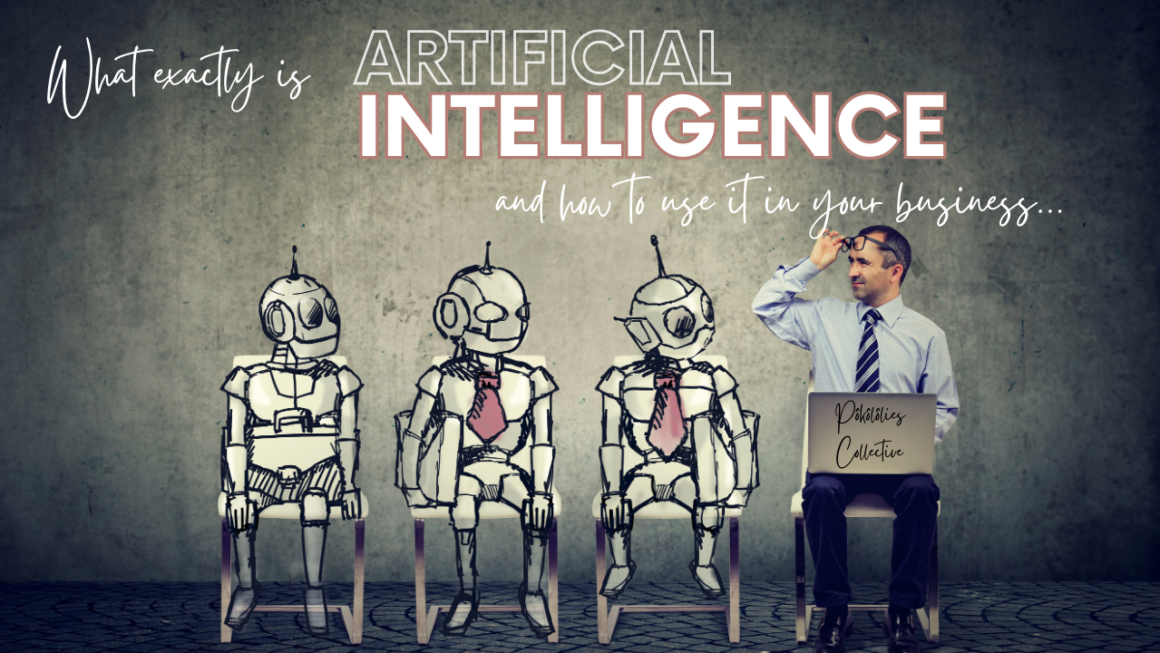
Understanding Artificial Intelligence: How to use it with Confidence
AI – A friendly Guide for the Beginner
Hi there! These days Artificial Intelligence (AI) is everywhere and it is the buzz of the day. If we are not using it or can not confidently talk about AI, it seems that we are trailing behind or losing out. It might even seem stupid to ask and therefore we sometimes just nod our heads in conversations, pretending to understand or just ignore it. Let’s break it down into simple, easy-to-understand terms and explore ways in which you or your business can use it to make life easier.
AI is like having a super-smart assistant that can learn and make decisions based on the information it gets. It’s not just in sci-fi movies anymore; today it is part of our everyday lives!
How AI Helps Small Businesses
For small businesses, AI can be a game changer. Imagine having an assistant that never sleeps and is always eager and ready to help. AI can manage schedules, handle customer service with chatbots that answer queries all day and night, and even help in predicting what products will sell best! This can save a lot of time and money and allow business owners to focus on growing their business.
Some Basic AI Terminology
Algorithms, machine learning, and neural networks are three foundational components in the creation of AI-generated content. Each plays a crucial role in how AI systems understand, learn from data, and produce new content. Let’s break down how each of these elements is utilized:
1. Algorithms
An algorithm in AI is a set of rules or instructions that tells the machine how to solve a problem, make decisions or achieve a specific outcome. In the context of AI-generated content, algorithms determine how the AI processes input (such as text or data points), how it learns from this input, and how it generates its output. For instance, an algorithm could be designed to analyse text data and learn how to formulate sentences that are grammatically correct and contextually relevant.
2. Machine Learning (ML)
Machine Learning is a subset of AI that focuses on the idea that systems can learn from data, identify patterns, and make decisions with minimal human intervention. In generating content, ML models are trained on large datasets of existing content to learn the style, structure, and complexities of language or other forms of data (like images or music).
For text, this involves:
- Training: Feeding large amounts of text data into the ML model so it can learn how language is structured.
- Model Adjustment: The model makes predictions about new content. When it makes errors, it adjusts itself based on these mistakes to improve future outputs.
- Content Generation: Once trained, the ML model can generate new text that mimics the learned style and content.
3. Neural Networks
Neural networks, particularly a type called deep neural networks, are a series of algorithms that attempt to recognize underlying relationships in a set of data through a process that mimics the way the human brain operates. This is especially useful in AI-generated content for:
- Pattern Recognition: Neural networks identify and replicate patterns in data. In text, this could be linguistic styles or common ways of structuring information.
- Generative Tasks: For generating new content, neural networks like GANs (Generative Adversarial Networks) and RNNs (Recurrent Neural Networks) are popular. GANs involve two neural networks contesting with each other to create increasingly better outputs, while RNNs use sequences (like sentences in a paragraph) to predict what comes next, making them ideal for text generation.
Applications in AI-Generated Content
- Text: AI systems like GPT (Generative Pre-trained Transformer) use neural networks to generate coherent and contextually relevant paragraphs of text based on prompts they receive.
- Images: Tools like DALL-E use neural networks to generate images from textual descriptions.
- Music: AI can compose music by learning from a vast dataset of music genres and styles, creating new compositions that reflect learned patterns and structures.
The integration of algorithms, machine learning, and neural networks allows AI to not just mimic human-like content but also innovate within the creative space, adapting to new styles and formats as more data becomes available. This results in continually improving AI capabilities in content generation across various media.
Why AI should be seen as a tool rather than a threat and how AI can help SMEs achieve their business goals
- Supportive, Not Substitutive: The primary role of AI in SMEs is to support and enhance the capabilities of human employees, not to replace them. AI automates repetitive and time-consuming tasks such as data entry, invoicing, and customer support queries. This allows human employees to focus on more strategic, creative and high-impact work that add value to the business, leading to higher efficiency and increased productivity.
- Accessibility and Customizability: Modern AI tools are more accessible and customisable than ever before, meaning that businesses of all sizes, including SMEs, can use them according to their specific needs and budget constraints.
- Enhanced Competitiveness: AI can level the playing field, allowing smaller businesses to compete with larger companies. It offers advanced technologies that were once accessible only to large corporations with significant resources.
- Job Creation: While AI automates certain tasks, it also creates new job opportunities in areas like AI management, data analysis, and system maintenance. It encourages employees to upgrade their skills, aligning with future-oriented job roles.
- Innovation Driver: AI stimulates innovation by providing tools to explore new business models, develop new products, and enter new markets. It acts as a catalyst for innovation, pushing SMEs to adopt more agile and forward-thinking approaches.
- Data-Driven Insights: AI tools can analyse large volumes of data to provide insights that businesses might not notice. These insights can help SMEs make informed decisions about everything from inventory management to marketing strategies, optimising operations and improving customer satisfaction.
- Personalisation: AI can tailor experiences to individual customers by analysing their behaviour and preferences. This level of personalisation can enhance customer engagement and loyalty, which are crucial for business growth, especially in competitive markets.
- Cost Reduction: By improving operational efficiency and reducing errors, AI can help SMEs save on operational costs. Additionally, AI can optimise resource allocation and energy consumption, further lowering expenses.
- Scalability: AI systems can handle increasing amounts of work as the SME grows. This makes it easier for businesses to scale up their operations without a corresponding increase in overheads or workload on existing staff.
In Summary
AI should be seen as a strategic tool that complements the skills of human workers in SMEs, and not replacing them. By adopting AI, small and medium-sized businesses can not only enhance their operational efficiencies and capabilities, but also ensure they remain competitive and relevant in a rapidly evolving business environment.

